

Key points
- In Switzerland, gastric bypass and sleeve gastrectomy are the most commonly performed operations. Other techniques exist: they differ in how they work and in how much scientific evidence is available.
- The Swiss framework is summarised further down, together with the status of each procedure.
- You can be welcomed and supported at the Centre in Nyon, whichever procedure is being discussed.
Five procedures at a glance
These techniques change the stomach, the intestine, or both. They are described here to help you understand options you may hear about; the choice of operation is discussed with you by the multidisciplinary team.
Duodenal switch (BPD-DS)
- How it works. The stomach is reduced as in a sleeve gastrectomy, then the intestine is rearranged so that food only meets bile and digestive juices over a short section of intestine, before the large intestine. Absorption of fat and some nutrients is greatly reduced.
- Where it fits. Considered mainly when BMI is very high, sometimes as a second step after a sleeve gastrectomy.
- Established constraints and risks. More digestive side effects and deficiencies than after a gastric bypass; close nutritional follow-up and lifelong supplements1, 2.
- Status in Switzerland: a complex procedure, performed in specialist referral centres2.
SADI-S
- How it works. A sleeve gastrectomy is performed first. The duodenum, the first part of the intestine leading out of the stomach, is then divided a few centimetres after the pylorus, the muscle that closes the outlet of the stomach. The part still attached to the stomach is joined, at a single point, to a loop of the last part of the small intestine, the ileum. Food therefore passes from the stomach straight into the ileum; bile and digestive juices travel through the bypassed part of the intestine and meet the food at this join, in the common section of intestine that leads to the large intestine3. Compared with the duodenal switch, it has one join instead of two.
- Where it fits. A variant of the duodenal switch, discussed in comparable situations.
- Established constraints and risks. Nutritional deficiencies are common; nutritional follow-up and lifelong supplements are needed4.
- Status in Switzerland: “under evaluation”, only as part of a study2.
Transit bipartition
- How it works. A sleeve gastrectomy is combined with a join between the stomach and the last part of the small intestine. Some of the food passes directly to this part of the intestine, the rest follows the usual route through the duodenum; no segment of intestine is excluded.
- Where it fits. A recent technique, offered only in a research setting.
- Established constraints and risks. Long-term effects are still poorly known, for lack of sufficient follow-up5.
- Status in Switzerland: “under evaluation”, only as part of a study6.
SASI
- How it works. A variant of transit bipartition: after a sleeve gastrectomy, the stomach is joined at a single point to a loop of the last part of the small intestine. Some of the food passes through this connection; the rest follows the usual route.
- Where it fits. A recent technique, offered only in a research setting.
- Established constraints and risks. Long-term effects are still poorly known, for lack of sufficient follow-up5.
- Status in Switzerland: “under evaluation”, only as part of a study6.
One-anastomosis gastric bypass (OAGB or “mini-bypass”)
- How it works. A long, narrow stomach pouch is joined at a single point to a loop of small intestine.
- Where it fits. Widely performed outside Switzerland and recognised by IFSO5.
- Established constraints and risks. Bile reflux, ulcers at the join and deficiencies have been reported7.
- Status in Switzerland: “under evaluation”, only as part of a study6, 8.
A newer technique is not necessarily better: its value is judged on results followed over many years.
Further reading: studies, evidence and open questions
This section summarises the available studies and the questions still under debate. It does not change the status shown above.
- Duodenal switch. A Scandinavian randomised trial followed people with a BMI of 50 to 60 for more than ten years: weight loss was greater than after a gastric bypass, but with more side effects and deficiencies1.
- SADI-S. First proposed in 2007, it is recognised by IFSO (the International Federation for the Surgery of Obesity and Metabolic Disorders). In its update published in 2024, IFSO notes that high-quality evidence is still scarce and calls for more long-term studies and randomised trials5, 4.
- Transit bipartition. In 2022, IFSO noted the absence of randomised trials and recommended offering this technique only within an approved research protocol5. Randomised trials have been published since then, with small numbers of patients and short follow-up; the most recent, published in 2026, covers one year and its authors consider longer follow-up necessary9, 10.
- SASI. In 2022, IFSO recommended offering it only within an approved research protocol5. A randomised trial published in 2025 compared it with a closely related variant; a protocol for a randomised trial comparing it with sleeve gastrectomy was published in 202611, 12.
- One-anastomosis gastric bypass. Data beyond five years are less plentiful7. A risk of cancer due to this operation has not been demonstrated: the question is raised by analogy with older, comparable surgical reconstructions, and it explains the SMOB’s caution2, 7.
Publications reviewed up to 15 October 2026.
The Swiss framework in brief
- Sleeve gastrectomy and gastric bypass: basic procedures, performed in all recognised centres, including Hôpital de Nyon (GHOL).
- Duodenal switch and two-stage procedures: complex procedures, performed in specialist referral centres.
- One-anastomosis gastric bypass, SADI-S, transit bipartition, SASI: procedures “under evaluation”, performed only as part of a study approved by an ethics committee, in a specialist referral centre.
The Swiss guidelines in detail
The guidelines of the SMOB (the Swiss society for obesity surgery) distinguish three groups of procedures6:
- Basic procedures (gastric band, sleeve gastrectomy, gastric bypass): may be performed in all recognised centres.
- Complex procedures (biliopancreatic diversion with or without duodenal switch, two-stage procedures, reoperations): reserved for specialist referral centres.
- Procedures “under evaluation” (including the one-anastomosis or “mini” gastric bypass, and any procedure not listed in the first two groups): only as part of a prospective study approved by an ethics committee, in a specialist referral centre.
Transit bipartition and SASI are not named in the guidelines: they belong to the category of procedures not listed in the first two groups.
Basic health insurance covers obesity surgery when the indication, the operation and the follow-up comply with these guidelines13.
Gastric band, balloon and endoscopic techniques
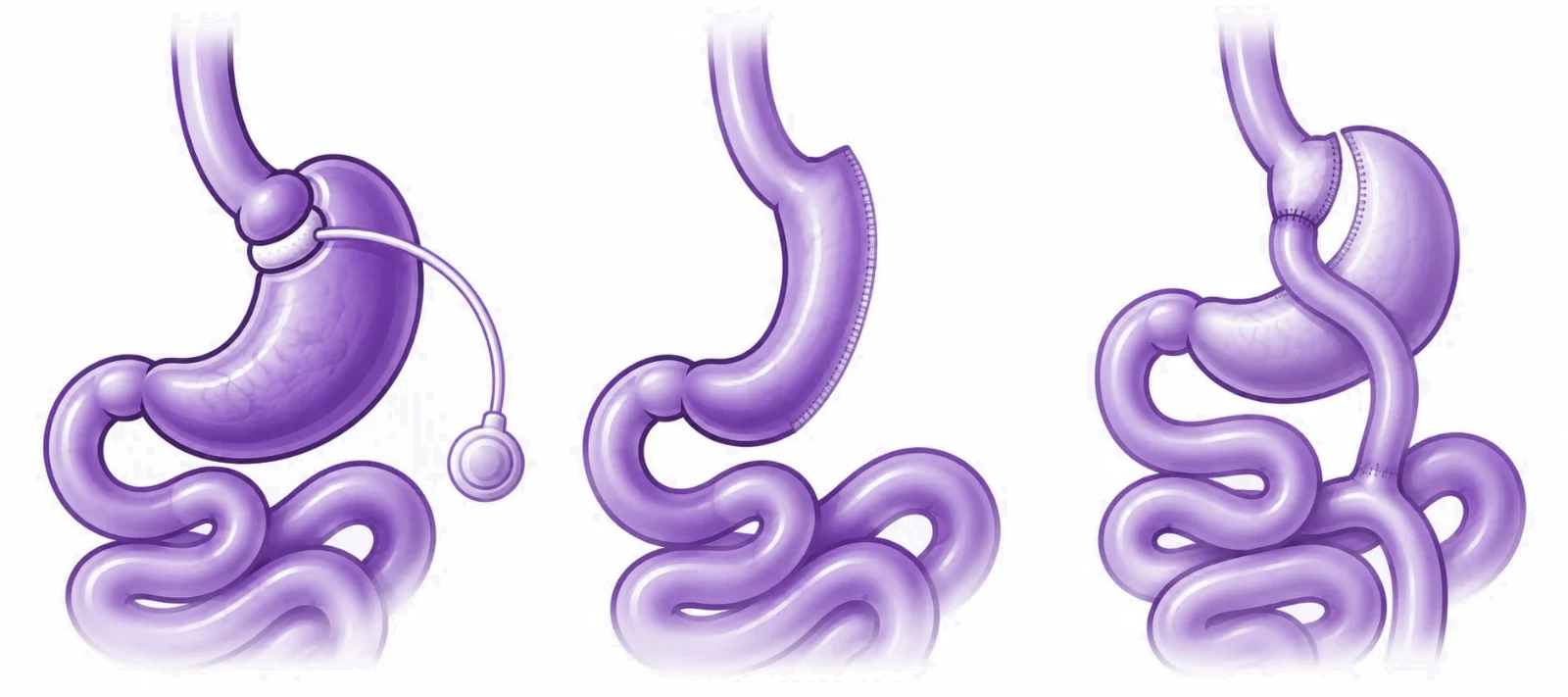
From left to right: adjustable gastric band, sleeve gastrectomy, gastric bypass.
Simplified diagram, not to scale.
The gastric band is still listed among the basic procedures, but it is now hardly ever fitted6, 8. If you have a gastric band, talk about it during a consultation: see You have already had surgery.
Endoscopic techniques remain “under evaluation” in Switzerland6. The gastric balloon is not covered by basic health insurance13.
Staged approaches
For some people, particularly when BMI is very high, surgery may be done in two stages: a sleeve gastrectomy first, then, if needed, a second operation such as a gastric bypass or a duodenal switch. See What care is available when BMI is over 50?
Depending on the situation, medication may also support preparation or complement care after the operation: see Medication and surgery: complementary approaches.
At the Centre
The team’s operations take place at Hôpital de Nyon, which appears on the SMOB list of recognised centres as a primary centre14. As a primary centre, it performs basic procedures.
You can be welcomed and supported at the Centre in Nyon, including when your BMI is over 50. Your assessment, preparation and follow-up can be organised there. If your operation requires a specialist referral centre, we coordinate this step with the appropriate hospital. Wherever possible, and with the agreement of the host centre, Dr Pierre Fournier performs your operation there himself.
Depending on your situation, the appropriate hospital may be a specialist referral centre in Geneva (HUG), Lausanne or Neuchâtel.
Frequently asked questions
Can I have a procedure that is “under evaluation”?
In Switzerland, only as part of a study. If this question concerns you, talk about it during a consultation.
Can I be followed up in Nyon if the operation being considered must be performed in a specialist referral centre?
Yes. You can be welcomed and supported at the Centre in Nyon, including when your BMI is over 50. Your assessment, preparation and follow-up can be organised there. If your operation requires a specialist referral centre, we coordinate this step with the appropriate hospital. Wherever possible, and with the agreement of the host centre, Dr Pierre Fournier performs your operation there himself.
How can I know which operation suits me?
The choice takes into account your health, your associated conditions, your preferences, current knowledge and the Swiss framework. The choice of treatment is discussed with you and the multidisciplinary team. The decision is made collectively, taking into account your health, your expectations and your preferences. See Choosing an operation.
What next?
If one of these procedures raises questions for you, you can discuss it during a surgical assessment consultation.
Your request is received by the Centre’s appointments team, who will organise the next steps with you. You do not need to check for yourself whether you meet the criteria.
Medical review of the French version: Dr Pierre Fournier
Scientific sources and references
Sources accessed on 15 October 2026. Reimbursement rules and information on medicines change over time.
- Salte OBK, Olbers T, Risstad H, et al. Ten-year outcomes following Roux-en-Y gastric bypass vs duodenal switch for high body mass index: a randomized clinical trial. JAMA Netw Open. 2024;7(6):e2414340. View source
- SMOB. Surgical procedures: established procedures (basic and complex) and procedures not established in Switzerland (“in evaluation”), SMOB website page, undated, accessed on 15 October 2026. View source
- Eichelter J, Felsenreich DM, Bichler C, et al. Surgical technique of single anastomosis duodeno-ileal bypass with sleeve gastrectomy (SADI-S). Surg Technol Int. 2022;41:111-117. View source
- Ponce de Leon-Ballesteros G, Romero-Velez G, Higa K, et al. Single anastomosis duodeno-ileostomy with sleeve gastrectomy/single anastomosis duodenal switch (SADI-S/SADS) IFSO position statement—update 2023. Obes Surg. 2024;34(10):3639-3685. View source
- Haddad A, Kow L, Herrera MF, et al. Innovative bariatric procedures and ethics in bariatric surgery: the IFSO position statement. Obes Surg. 2022;32(10):3217-3230. View source
- Swiss Society for the Study of Morbid Obesity and Metabolic Disorders (SMOB). Directives pour le traitement chirurgical de l’obésité, in force from 1 July 2023 (in French). View source
- Mitra A, Bhambri A, Fehervari M, Parmar C. Long-term outcomes of one anastomosis gastric bypass: a systematic review and meta-analysis of 5-year and beyond. Obes Surg. 2026;36(1). doi:10.1007/s11695-025-08339-w. View source
- Gerber PA, Collet TH, Favre L, et al. Swiss obesity clinical practice guidance. Swiss Med Wkly. 2026;156:5415. View source
- Azevedo FR, Santoro S, Correa-Giannella ML, et al. A prospective randomized controlled trial of the metabolic effects of sleeve gastrectomy with transit bipartition. Obes Surg. 2018;28(10):3012-3019. View source
- Consalvo V, Rodriguez SG, Galli F, et al. Sleeve gastrectomy with Roux-en-Y transit bipartition versus sleeve gastrectomy for the treatment of obesity and reflux: a multicenter randomized controlled trial. Obes Surg. 2026 (published online 24 September 2026). View source
- Sewefy AM, Abdelzaher MA, Sabry K, et al. Single anastomosis sleeve jejunal (SAS-J) bypass vs single anastomosis sleeve ileal (SASI) bypass, prospective randomized controlled clinical trial. Int J Surg. 2025. View source
- Haug HM, Hagen RE, Kristinsson JA, et al. A two-center randomized clinical superiority trial of single-anastomosis sleeve ileal bypass versus sleeve gastrectomy for severe obesity: SASSY study protocol. Scand J Surg. 2026. View source
- Federal Office of Public Health (FOPH). Annexe 1 de l’ordonnance sur les prestations de l’assurance des soins (OPAS), edition of 1 July 2026: chapters 1.1 and 2.1 (in French). View source
- SMOB. List of recognised centres, as of 1 May 2026. View source
- Author
- Prepared for the Centre from the sources cited
- References
- See “Scientific sources and references” on this page