

Key points
- In Switzerland, gastric bypass and sleeve gastrectomy account for most operations.
- Their long-term effect on weight is similar. They differ mainly in their drawbacks.
- Neither is better for everyone: the choice is made with you, after the assessment.
Two standard operations
The bypass and the sleeve are the two most commonly performed operations in Switzerland1. They work in different ways:
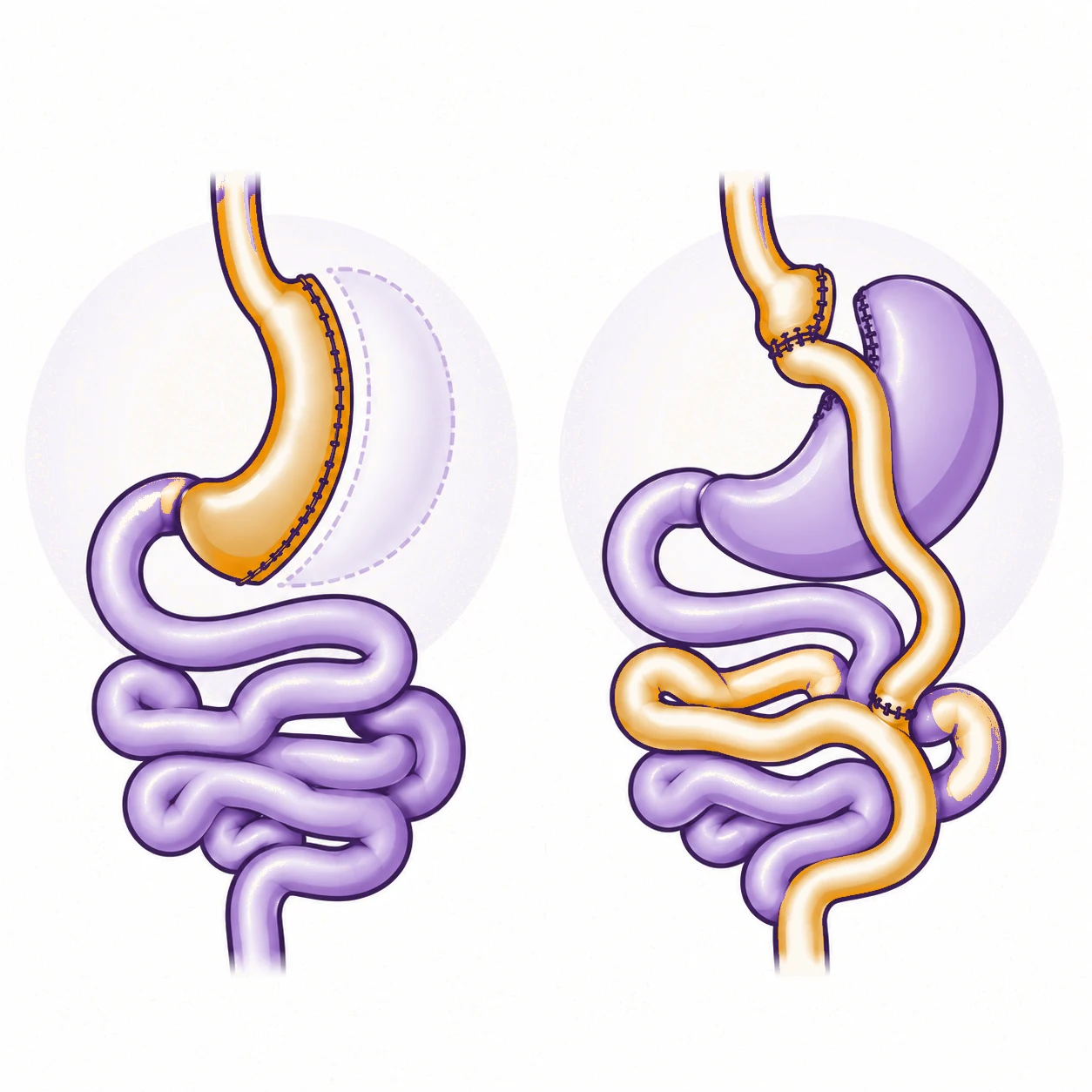
Left, the sleeve: the stomach is reduced to a tube and the route of food is unchanged. Right, the bypass: food passes from a small stomach pouch directly into the small intestine.
Simplified diagram, not to scale.
| Sleeve gastrectomy | Gastric bypass | |
|---|---|---|
| How it works | The stomach is reduced to a tube; the intestine is not changed | A small stomach pouch is joined to the intestine; part of the stomach and intestine is bypassed |
| Acid reflux | More common: the main drawback | Less common |
| Specific risks | Leak from the staple line; second operation for reflux, often by conversion to a bypass | Internal hernia; ulcer at the join (marginal ulcer); feeling unwell after meals |
| Follow-up | Vitamins, blood tests and check-ups for life | Vitamins, blood tests and check-ups for life; some medicines are absorbed differently |
The trials that compared them over ten years, in Switzerland and Finland, show a similar effect on weight; they differ mainly in their drawbacks2, 3.
What goes into the choice
According to the Swiss guidelines, the choice is not based on an algorithm, but on a shared decision made with a well-informed patient1. The choice of treatment is discussed with you and the multidisciplinary team. The decision is made collectively, taking into account your health, your expectations and your preferences. Factors include:
- acid reflux or a hiatus hernia, which tend to point towards the bypass;
- type 2 diabetes, plans for pregnancy;
- your medicines, whose absorption may change after a bypass, and any need for anti-inflammatory drugs;
- your health as a whole (BMI, age, previous operations, eating behaviour) and your preferences, once you understand the advantages and drawbacks.
To prepare for the discussion: questions to ask before obesity surgery (printable list).
What about other operations?
The gastric band has become rare. More complex operations are performed in specialist referral centres, and some recent techniques are only offered in Switzerland as part of a study4, 1. The intragastric balloon is not covered by basic (compulsory) health insurance5.
At the Centre
The team’s operations take place at Hôpital de Nyon (GHOL), which is on the SMOB list of recognised centres as a primary centre6. Situations that require a specialist referral centre include a BMI above 50, age under 18 or over 65, revisional surgery or metabolic surgery4.
You can be welcomed and supported at the Centre in Nyon, including when your BMI is over 50. Your assessment, preparation and follow-up can be organised there. If your operation requires a specialist referral centre, we coordinate this step with the appropriate hospital. Wherever possible, and with the agreement of the host centre, Dr Pierre Fournier performs your operation there himself.
Depending on your situation, the appropriate hospital may be a specialist referral centre in Geneva (HUG), Lausanne or Neuchâtel.
Frequently asked questions
Can the technique be changed later?
A sleeve can be converted into a bypass. Any second operation is revisional surgery, which is more delicate than the first and is performed in a specialist referral centre4.
What next?
If this page sounds like your situation, you can book a surgical assessment consultation. Its purpose is to review your situation and the possible options; any operation is then decided collectively by the team, with you.
Your request is received by the Centre’s appointments team, who will organise the next steps with you. You do not need to check for yourself whether you meet the criteria.
Medical review of the French version: Dr Pierre Fournier
Scientific sources and references
Sources accessed on 12 October 2026. Reimbursement rules and information on medicines change over time.
- Gerber PA, Collet TH, Favre L, et al. Swiss obesity clinical practice guidance. Swiss Med Wkly. 2026;156:5415. View source
- Kraljevic M, Süsstrunk J, Wölnerhanssen BK, et al. Long-term outcomes of laparoscopic Roux-en-Y gastric bypass vs laparoscopic sleeve gastrectomy for obesity: the SM-BOSS randomized clinical trial. JAMA Surg. 2025;160(4):369-377. doi:10.1001/jamasurg.2024.7052. View source
- Salminen P, Grönroos S, Helmiö M, et al. Effect of laparoscopic sleeve gastrectomy vs Roux-en-Y gastric bypass on weight loss, comorbidities, and reflux at 10 years in adult patients with obesity: the SLEEVEPASS randomized clinical trial. JAMA Surg. 2022;157(8):656-666. View source
- Swiss Society for the Study of Morbid Obesity and Metabolic Disorders (SMOB). Directives pour le traitement chirurgical de l’obésité, in force from 1 July 2023 (in French). View source
- Office fédéral de la santé publique (OFSP). Annexe 1 de l’ordonnance sur les prestations de l’assurance des soins (OPAS), edition of 1 July 2026: chapters 1.1 and 2.1. View source
- SMOB. Liste des centres reconnus, as of 1 May 2026. View source
- Author
- Prepared for the Centre from the sources cited
- References
- See “Scientific sources and references” on this page