

Key points
- The operation is done under general anaesthetic, through small incisions, at Hôpital de Nyon (GHOL).
- The stay usually lasts two to three nights; you are supported as you start eating again.
- Some signs mean you should call without waiting: the useful contacts are listed on this page.
The day of the operation
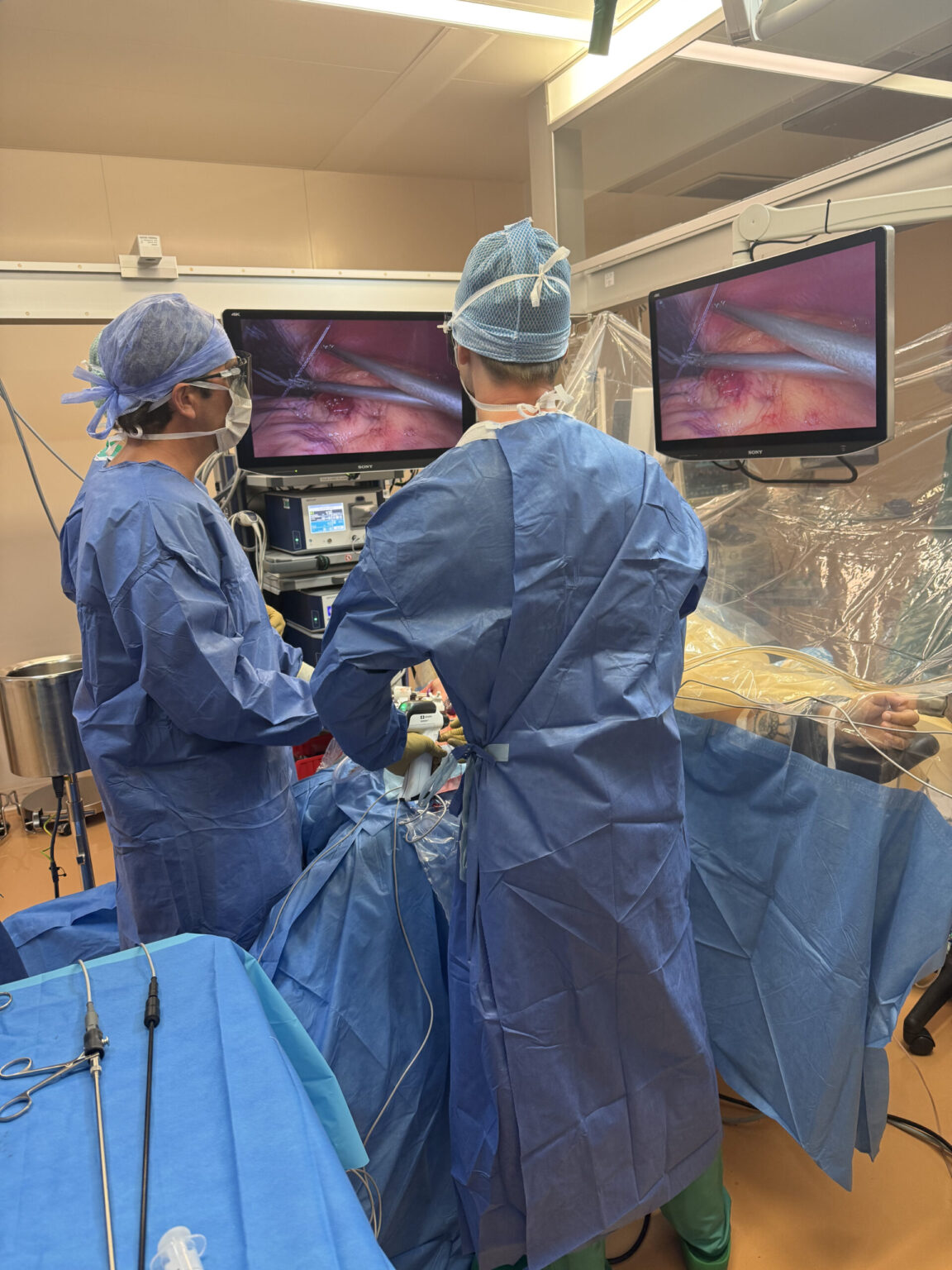
Before the operation, you receive instructions about fasting, your usual medicines and your admission time, and you have a consultation with the anaesthetist. The operation is carried out under general anaesthetic, by laparoscopy (keyhole surgery): the surgeon operates through small incisions, using a camera. You then spend time in the recovery room before going back to your room.
The stay
The hospital stay usually lasts two to three nights.
Getting moving and preventing blood clots
You are helped out of bed and moving early, with the support of physiotherapy, and measures are taken to prevent blood clots (thrombosis)1.
Supported return to eating
You start eating again gradually, with the team, following a programme adapted to your operation.
Going home and getting back to your activities
Before you leave, the team gives you written instructions on eating, activity and your medicines. Do not change your usual treatments yourself: some are adjusted after the operation. Returning to your activities and to work is planned individually: it depends on your job and on your recovery.
When should you call without waiting?
After obesity surgery, a complication may cause only a few symptoms. Do not wait for your next appointment if you have:
- abdominal pain that is severe, that lasts or that keeps coming back;
- repeated vomiting, or being unable to drink;
- fever, feeling faint or unwell, shortness of breath or palpitations;
- blood in your vomit or black stools;
- pain or swelling in one calf.
If in doubt, call. Always say that you have had an operation, and which one. Complications are preferably managed by the centre that operated on you2.
Who should you contact after an operation?
- During the day: the practice, on +41 22 990 33 11, or Hôpital de Nyon.
- Evenings and weekends: the Hôpital de Nyon switchboard, on +41 22 994 61 61, stating which operation you had.
- Life-threatening emergency: 144 (emergency medical services).
Frequently asked questions
Will it hurt?
Some pain is possible in the first few days, especially in the shoulders and abdomen; it is treated. Pain that gets worse after you return home should be reported.
Next steps
Medical review of the French version: Dr Pierre Fournier
Scientific sources and references
Sources accessed on 12 October 2026. Reimbursement rules and information on medicines change over time.
- Swiss Society for the Study of Morbid Obesity and Metabolic Disorders (SMOB). Directives pour le traitement chirurgical de l’obésité, in force from 1 July 2023 (in French). View source
- IFSO-EC, version adopted by the SMOB. La prise en charge en urgence du patient opéré de chirurgie métabolique et bariatrique (poster for emergency departments), 2026. View source
- Author
- Prepared for the Centre from the sources cited
- References
- See “Scientific sources and references” on this page